Mr McBain’s barn
Klara and the SunMr McBain’s barn is a rough, partly open shelter at the edge of the fields and the setting for Klara’s final appeal to the Sun for Josie. First seen from Josie’s bedroom as a dark shape against the evening glow, it becomes a place where childhood memory, scattered remnants of earlier scenes, and a possible sign of the Sun’s attention converge—yet its ordinary objects leave the meaning of that encounter unresolved.
Setting and First Appearance
From the rear window of Josie’s bedroom, Klara notices a box-like shape at the end of the furthest field. It remains fixed as the grass shifts and the Sun sinks almost to the grassline, seeming to stand directly in front of his glow. Josie identifies it as Mr McBain’s barn, though she qualifies the name: open on two sides, it is more like a shelter where Mr McBain keeps things. The structure’s plainness contrasts with Klara’s question about why the Sun would rest there, and Josie jokes that he ought to need a palace.
Josie recalls going to the shelter with Rick when they were little, before she became ill. They had walked until they were tired, found no gateway or steps that might lead to a hidden palace, and sat inside simply to rest in the shade before returning. She entertains the possibility that an entrance might be concealed or open only at sunset, but makes clear that the children had not been looking for anything extraordinary. As the Sun dwindles to a short line of light through the grass, Josie hopes he sleeps well. The recollection establishes the barn as a familiar childhood refuge before Klara later approaches it as a sacred or potentially responsive place.
Return at Sunset
On a later journey, Rick carries Klara across the fields. The grass has turned more yellow and feels softer than on their previous trip; after they pass the third picture-frame gate, the route remains open, with the barn visible ahead beneath a wide orange sky. The Sun is already near the peak of its triangular roof. At the low-cut grass, Klara asks Rick to stop and let her down. They watch the barn’s shadow extend across the patterned grass as the Sun drops behind the roof.
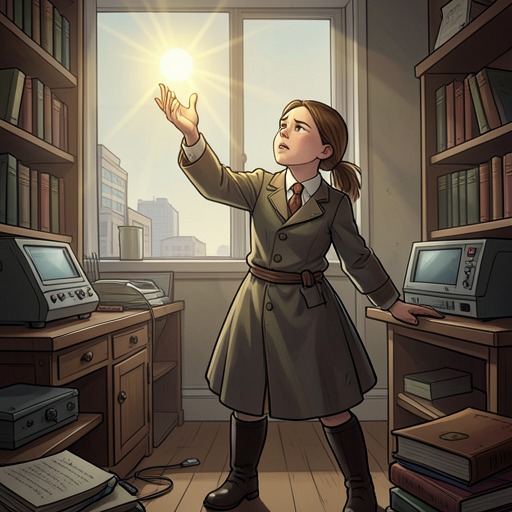
Klara asks Rick to leave her alone once the light has gone behind the roof structure, mindful not to take more privacy than necessary. He asks what happens inside but does not press for an explanation; he touches her shoulder kindly and promises to wait where he waited on their previous visit. Alone, Klara considers that the Sun may be angry because she failed to stop Pollution in the city, and that this may be her last opportunity to ask for help for Josie. Fear enters her thoughts, but remembering the Sun’s earlier kindness, she walks into the barn without further hesitation.
A Store of Fragments
The barn is filled with orange light, at first too intense for Klara to distinguish its contents. She soon makes out hay blocks stacked on her left and a low wall of hay that has become lower since her previous visit. Particles of hay move agitatedly in the light, as if a block has recently fallen onto the hard wooden floor and broken apart; when Klara reaches toward them, her fingers cast long shadows toward the entrance. The familiar building is not static: its shifting contents make the light-filled shelter feel both materially specific and strangely unsettled.
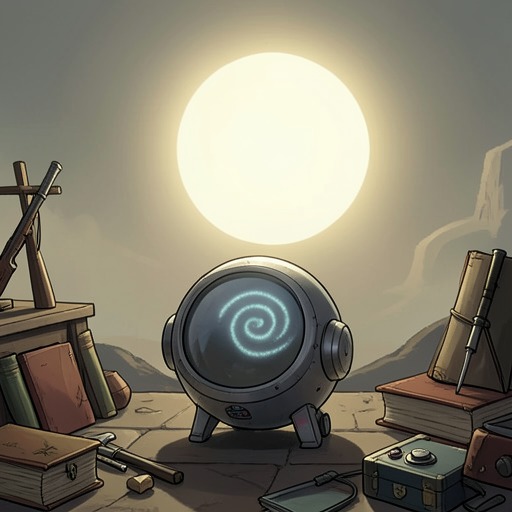
On the far wall, the Red Shelves from Klara’s old store remain attached, now crooked and slanting toward the rear. The ceramic cups are still arranged in an orderly line, but Melania Housekeeper’s food blender has appeared among them, introducing an incongruous domestic object into the display. Klara also looks for the metal folding chair on which she sat during her previous visit and for the store’s front alcove. Instead, she sees sunlight crossing the barn almost horizontally from rear entrance to front, like traffic passing along a busy street. The opposite side has broken into uneven boxes; the chair itself seems to have been divided among several of them. Familiar things recur, but no longer in their former arrangement.
The barn’s shifting boxes hold further fragments. An angry phrase in cartoon lettering recalls writing Klara saw on a city building; a large oval photograph shows four sheep in a green field, the same animals she had glimpsed from the Mother’s car after the trip to Morgan’s Falls. In the photograph, the sheep appear suspended above the ground, their mouths unable to reach the grass they seem to be eating, changing a remembered image of happiness into one of sadness. A protruding corner of Josie’s paperback, dropped earlier in the Friend’s Apartment, initially resembles a small piece of pie. Elsewhere, bright bottles and parts of a “Recessed Lighting” sign recall the display in the store’s new window. These objects do not explain the barn; they give Klara’s vigil the texture of a place in which separate episodes and memories have become visible together.
Klara’s Appeal to the Sun
Klara addresses the Sun with an apology for failing to stop Pollution and for failing to anticipate a second machine that could continue it. She recalls that the Sun was watching at the Yard when she tried, and that she made a sacrifice; she also stresses that the Father helped because he saw her hope and trusted it, though he knew nothing of her agreement with the Sun. Klara accepts responsibility for underestimating the task and asks that Josie not be blamed: Josie does not know of the bargain, and her strength is declining. Klara asks the Sun to give Josie the special nourishment that she believes he once gave Beggar Man and his dog.
The appeal becomes more personal as Klara asks the Sun to consider Josie and Rick. She recalls how delighted he seemed when Coffee Cup Lady and Raincoat Man found each other again, and argues that he must understand the value of people who love one another and are reunited. Josie and Rick, she says, are young and have grown up as parts of each other; if Josie dies, they will be separated. Their childhood drawing, “Rick and Josie forever,” stands behind Klara’s hope that they might enter adult life together. She acknowledges that asking the Sun to make an exception is a request for favoritism, but insists that the young couple’s lasting love makes them deserving of help. Her plea turns the barn into the setting for a moral argument: she cannot claim success in her own mission, so she asks for mercy on Josie’s behalf.
Glass, Reflection, and Uncertainty
As the Sun’s light fades, Klara notices a separate glow behind her and turns toward it. For a moment, the reflection appears so bright and low that she thinks the Sun has entered the barn. She corrects herself: as with the windows of the RPO Building and other buildings, a reflective surface is catching his image. Seven rectangular sheets of glass, stacked almost upright against a wall, hold the setting Sun’s face. Their likely practical purpose is suggested by the possibility that Mr McBain intends to use them as windows in the shelter’s missing walls, but the narrative does not confirm his plans.
The glass produces not one stable image but several superimposed faces, one on each sheet. The outermost appears forbidding and aloof, as does the face immediately behind it; the next two seem softer and kinder, and Klara estimates that the three farther back may look humorous and kind. Together, their different expressions form the impression of a single face with multiple outlines and emotions. The image can be read as a reflection distorted by layers of glass, but within Klara’s vigil it also sustains her hope that the Sun has received her appeal. She asks once more for his special kindness to Josie. When the faces fade together and the barn darkens, she thanks him for receiving her and apologizes again for failing to perform the service she promised, while recognizing that the Sun has departed.
The barn offers no explicit confirmation that Klara’s request has been granted. Its significance lies instead in the way its ordinary shelter, old store fixtures, scattered personal objects, and accidental reflections gather the book’s uncertainty into one place. Klara’s final understanding remains a hope rather than a proven answer: she later considers that the Sun may already have known Josie and Rick would part, while understanding that their love could endure and perhaps, like Coffee Cup Lady and Raincoat Man, bring them together again after many years and changes.